The Inspiration Canvas
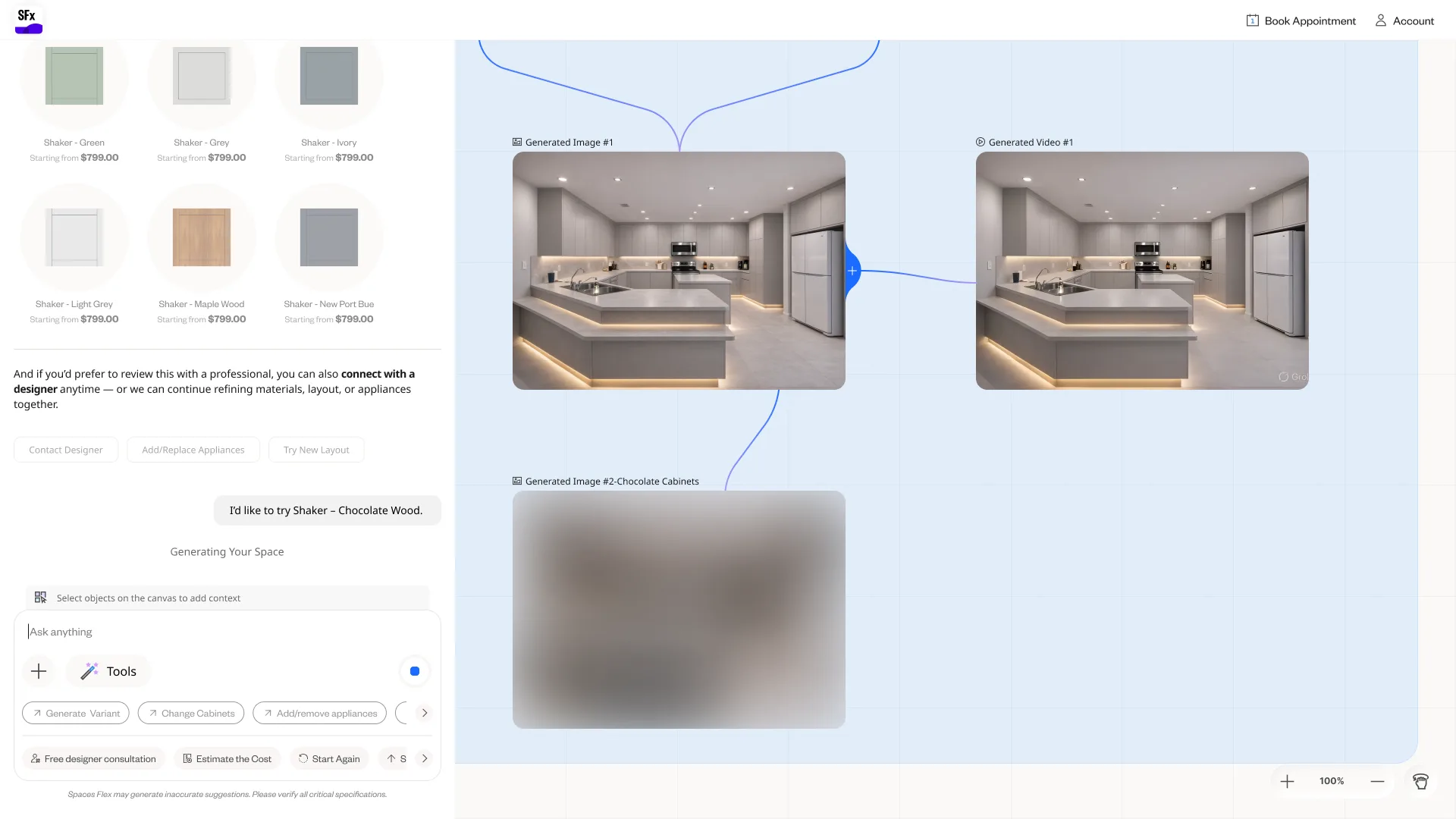
Design exploration is rarely a straight line. Leap Rethink turns it into a freeform canvas — pull in anything, generate images, video and variants as nodes, and branch ideas into connected explorations, all grounded in the real catalog.
- Product
- Spaces Flex · Leap Rethink
- Freeform NLP canvas
- Stage
- Discovery
- Validated with multiple test users
- Focus
- Generative canvas · multimodal input · branching exploration
- Role
- Concept & interactive prototype
Choosing a kitchen is messy, non-linear exploration. People gather photos, change their mind, compare directions, branch off and come back. A single linear flow — answer, generate, refine, repeat — flattens all of that into one track, and loses the comparisons and dead-ends that are how people actually decide. The question behind this discovery: what if the tool gave exploration room to breathe — a canvas where ideas can multiply, branch and sit side by side?
This is a discovery concept — “Leap Rethink” — for Cyncly's Spaces Flex, exploring a freeform alternative to the linear NLP flow. It was prototyped end-to-end and validated with multiple test users, and is planned for implementation as scope and resourcing allow. The aim was to prove the model — open, branching, multimodal exploration that still resolves to real, catalog-grounded products and a designer hand-off — before building it.
Constraints
- A freeform canvas has to stay legible, not become a cluttered mess — the exploration should feel open but navigable.
- Inputs arrive in many forms (photo, sketch, floor plan, inspiration, web imports) and outputs in several (image, video, variants) — all as nodes that relate to each other.
- However far exploration branches, every option must stay grounded in the real catalog — selectable, specifiable products, not just renders.
- It has to bridge open exploration to a decision: a clear path to refine, cost, or hand off to a human designer.
Exploration isn't a straight line
People don't choose a kitchen in one pass. They collect references, try a direction, back out, compare two options, branch off on a tangent and circle back. A linear flow — answer the questions, generate, refine, repeat — quietly erases most of that: the comparisons, the branches, the ideas held side by side.
Leap Rethink asks what happens if the tool gives that exploration room. Not a single track, but a freeform canvas — closer to Miro or FigJam — where inputs and AI-generated outputs live as nodes you can branch, connect and compare, while everything still resolves to the real catalog.
A canvas, not a conversation thread
A linear chat is simple to follow but forces one idea at a time; everything earlier scrolls away. Real exploration wants several ideas visible at once, with the relationships between them.
Options weighed
- Keep the linear NLP flow: familiar, but it flattens branching exploration into a single track.
- A gallery of results: shows options, but loses how they relate and where they came from.
- An infinite canvas of connected nodes — inputs and generated outputs you can branch, link and compare.
Decision
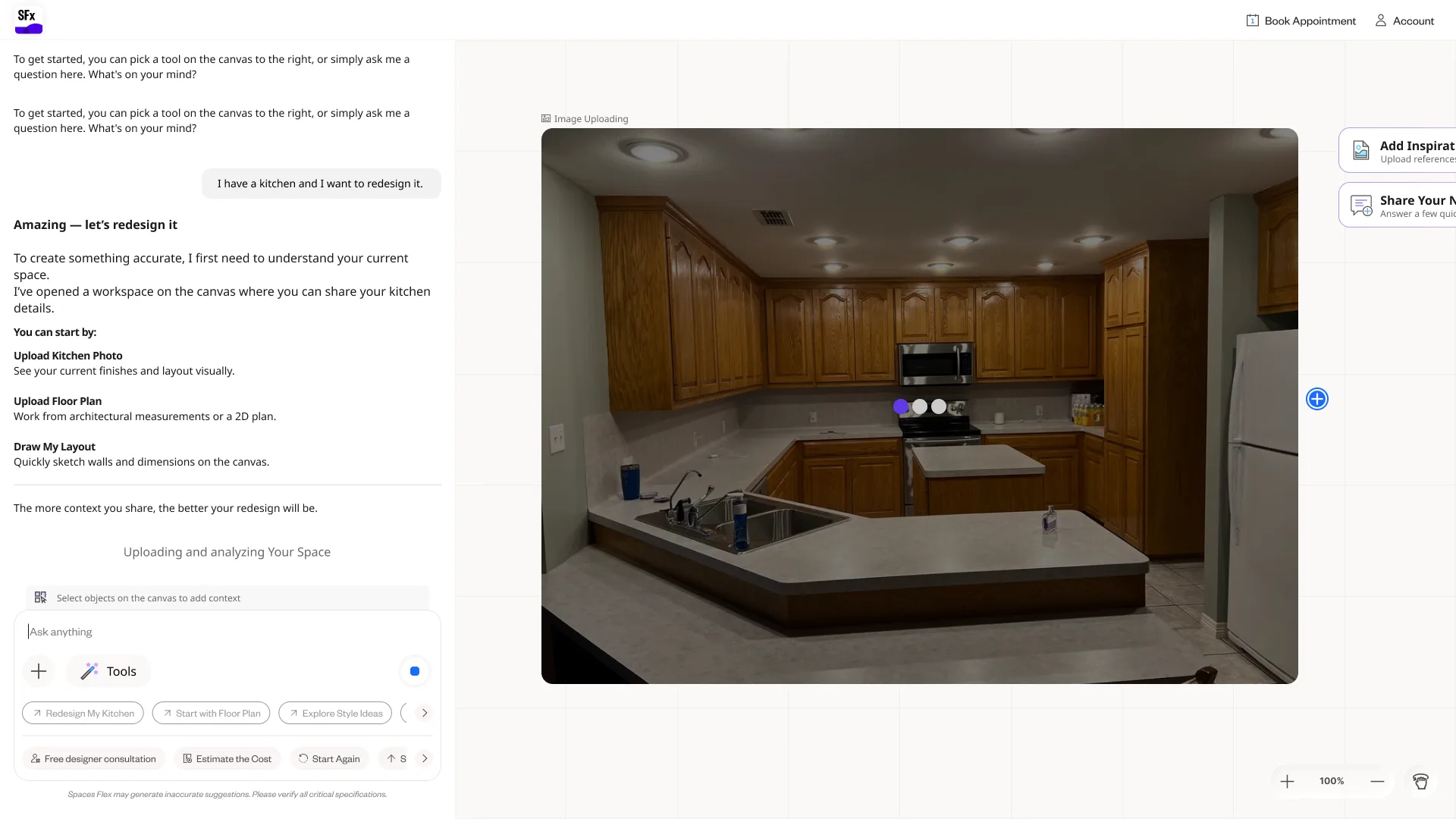
A **freeform canvas** where each input and each AI output is a node. Ideas branch into connected explorations you can see side by side — with the conversation alongside to drive it — so the structure of the exploration is visible, not lost in a scroll.
Trade-off — A more complex surface to design and keep legible, in exchange for matching how people actually explore — in branches and comparisons, not a single line.
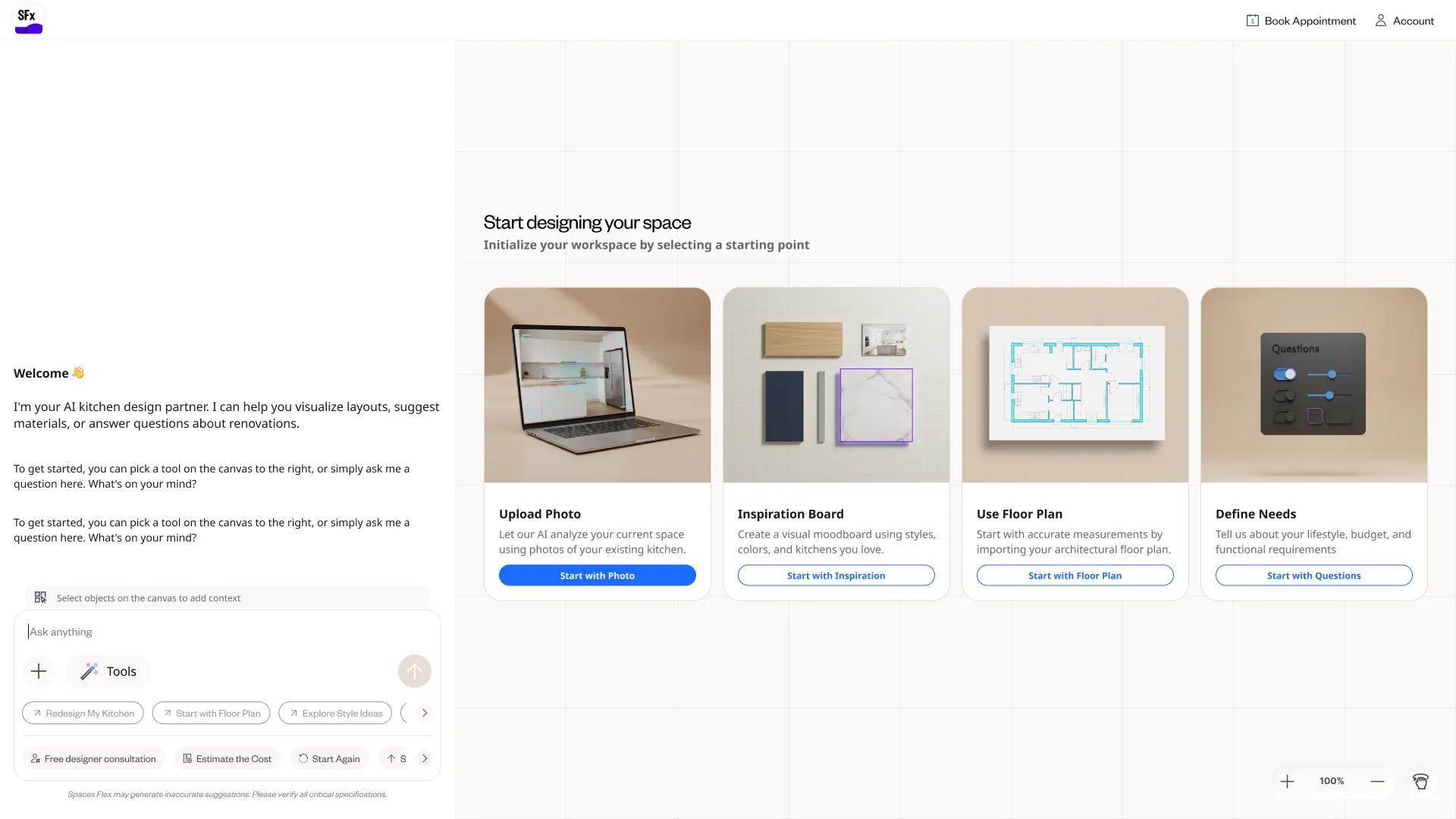
How the canvas works
- 01
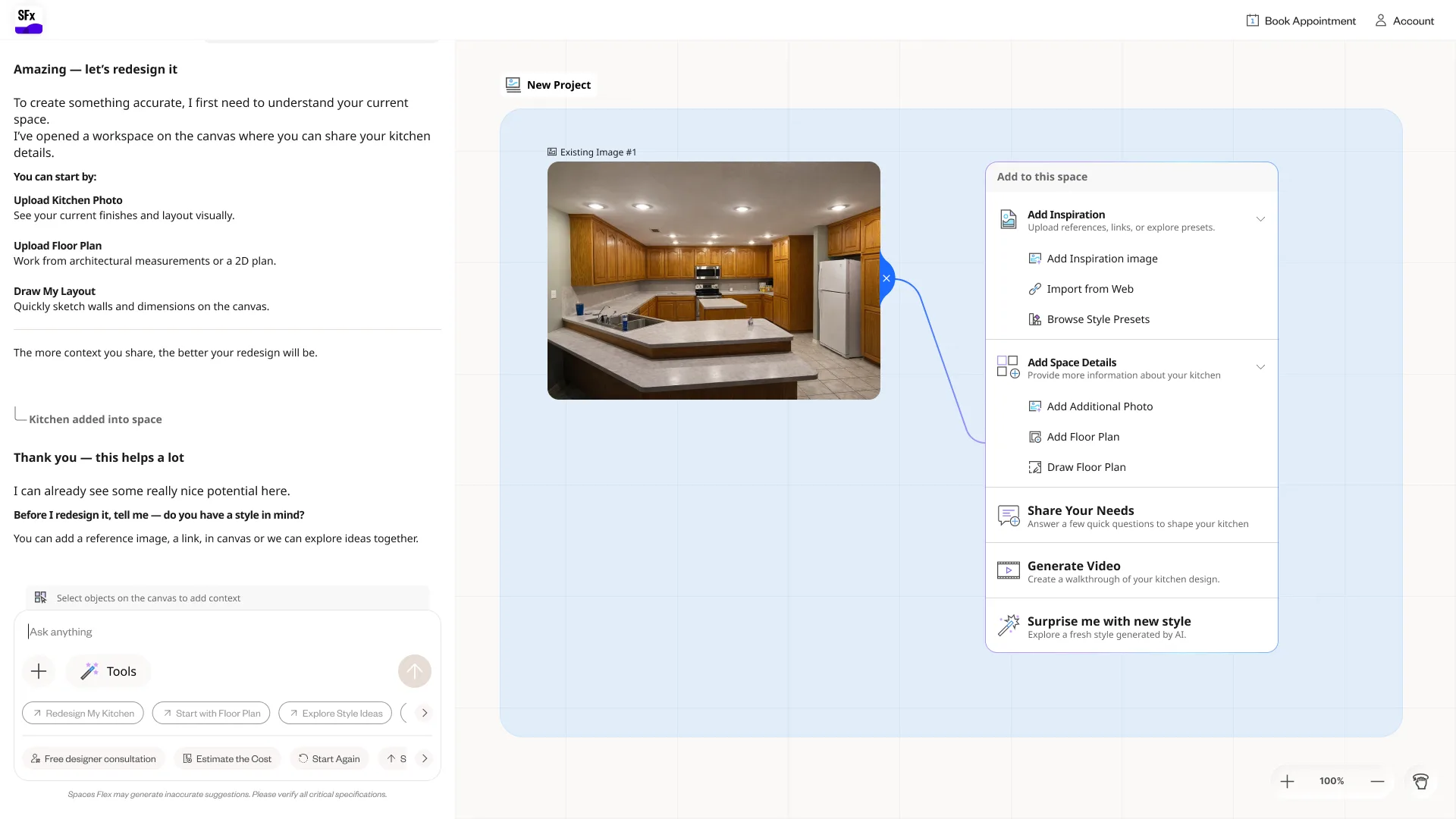
Bring anything in
Upload a photo or floor plan, sketch on the canvas, add inspiration, or import references from the web — each lands as a node.
- 02
Generate from it
NLP turns the inputs into outputs — generated images, a video walkthrough, style variants — placed as new nodes.
- 03
Branch & compare
Spin any node into new directions; connected branches sit side by side so options can be weighed, not just scrolled past.
- 04
Ground & hand off
Every direction resolves to real catalog materials and products — then estimate the cost or hand off to a designer.
One idea, many branches
Open exploration, still grounded
A freeform generative canvas can drift into pretty pictures that can't be bought. The value only holds if every branch stays connected to real, specifiable products.
Options weighed
- Pure moodboard: inspiring, but nothing on it is actually purchasable.
- Lock it to a configurator: real, but it kills the open, exploratory feel.
- Keep the canvas free, but resolve every node to real catalog materials and products underneath.
Decision
Let exploration stay open while every node stays **grounded in the real catalog** — materials with names and prices, selectable products — so a branch people love is already a buildable direction, with a path to cost it or take it to a designer.
Trade-off — Tighter coupling between a free-form canvas and live catalog data, in exchange for exploration that's actionable, not just aspirational.
Grounded, and ready to decide
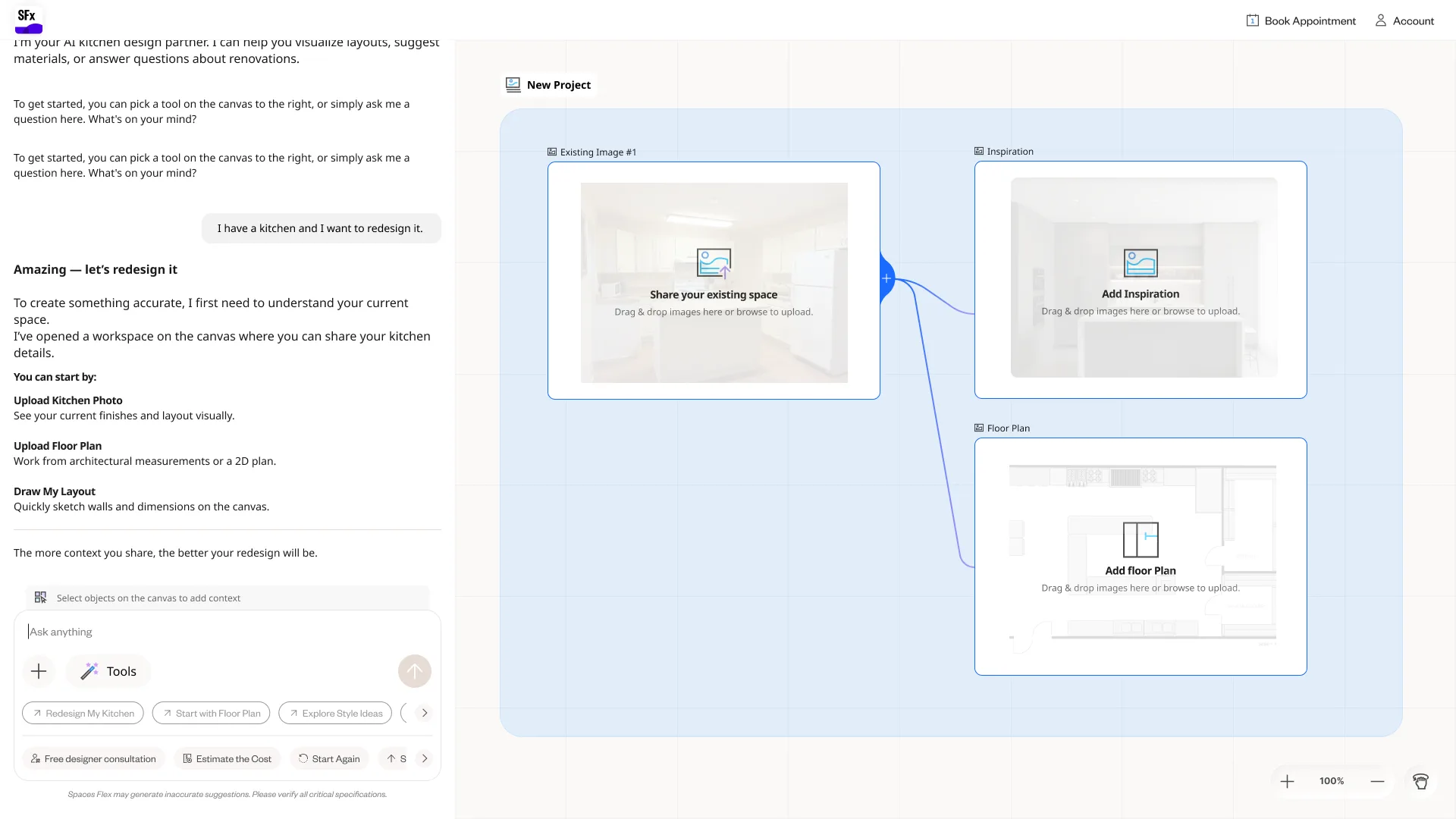
The whole exploration, screen by screen
The sections above show the thinking; this is the breadth. Click any screen to enlarge, and scroll across — entry and inputs, the canvas, generation, branching, the node graph, materials, and the hand-off.
What the discovery proved
A concept prototyped end-to-end and tested with multiple users — with a clear, positive signal and a path to build.
- Branching matched how people explore
- Comparing directions side by side, rather than one-at-a-time, mapped to how people actually decide.
- Multimodal + multi-output felt natural
- Bringing in photos, sketches, floor plans and web imports — and getting images, video and variants back — made sense to users.
- Grounding kept it credible
- Keeping every node tied to the real catalog is what separated it from a generic moodboard tool.
- Planned to build
- A validated direction, scoped for implementation as resourcing allows — with open questions on canvas performance and generation cost at scale.
In closing
What changed
- A freeform, Miro/FigJam-style inspiration canvas for kitchen design — inputs and AI outputs as nodes you can branch, connect and compare.
- Multimodal input (photo, sketch, floor plan, inspiration, web imports) and multi-output generation (images, a video walkthrough, variants), all on one canvas.
- Branching exploration that stays grounded in the real catalog — selectable materials and products with prices — and bridges to cost estimation or a designer.
- A concept validated with multiple test users and scoped for implementation.
What's still open
- Canvas performance and the cost of generation as explorations grow large.
- Keeping an open, branching canvas legible and navigable — not a cluttered board.
What I learned
Exploration is branching, not linear — and a tool that respects that can be both more creative and more decisive. The design challenge wasn't the generation; it was giving open exploration structure (nodes, branches, a readable map) while keeping every idea tied to real, buildable products. Testing confirmed the pull: people wanted room to explore sideways, as long as what they found was real.
The NLP Planner